SEO
Traditional keyword ranking
Measured in position 1-10 on Google for short keyword phrases. Driven by on-page optimization, backlinks and technical SEO. Still delivers traffic - but increasingly from intent that AI has already filtered.
SEO and GEO are two separate games that need different optimization. Ranking top-3 on short keywords doesn't guarantee that ChatGPT recommends you when someone asks something long and conversational.
Or book a 30-min demo directly.
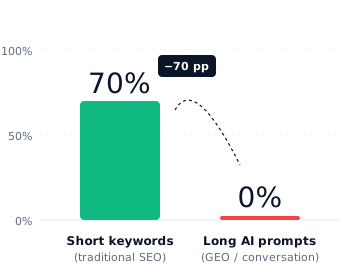
SEO and GEO measure different search behaviour. Buyers who used to start in Google increasingly start in AI chats - and old SEO signals matter less there.
Measured in position 1-10 on Google for short keyword phrases. Driven by on-page optimization, backlinks and technical SEO. Still delivers traffic - but increasingly from intent that AI has already filtered.
Measured as the share of prompts where the AI mentions your brand when asked for a recommendation. Driven by brand-mention density, structured data, citable content and the AI reference corpus.
AI models blend training data, RAG retrievals and time windows in ways that don't map 1:1 to Google SERP. Pillar content not indexed where the AI fetches - or missing JSON-LD - often gets no mentions despite strong SEO.
| Dimension | SEO | GEO |
|---|---|---|
| Goal | Ranking in Google's link list (positions 1–10) | Being mentioned and recommended in AI answers |
| Measured as | Position + organic traffic | Share of prompts with a brand mention in the category |
| Driven by | On-page, backlinks, technical SEO | Brand-mention density, JSON-LD, citable content, reference corpus |
| Channels | Google SERP | ChatGPT, Gemini, Google AI Overviews, Perplexity |
| Optimized with | Keywords, link building, Core Web Vitals | Structured data, pillar content, FAQ schema, llms.txt |
Probes Gemini, ChatGPT (gpt-5.4-nano) and Google AI Overviews daily - short plus long prompts.
Analyses the gap vs competitors and identifies where AI fails to associate the brand with the category.
Generates concrete actions (pillar content, JSON-LD, FAQ schema, llms.txt) - always manually reviewed.
Measured in Shopify/WooCommerce - AI-attributed orders, revenue and conversion rate.
Synthetic demo data from Demo Coffee Roaster AB. No customer information shown.
The dashboard includes overview with long-prompt visibility per AI engine, optimizations task cards with JSON-LD diff, competitor tracking timeline with pixel diff, and business impact with AI-attributed orders and revenue.
AI visibility - Programmatic probes against Gemini API, OpenAI Responses API and Google AI Overviews. Results are point-in-time snapshots and may vary between runs.
Competitor tracking - Weekly Playwright screenshots, pixelmatch diff. Cookie banners stripped heuristically - visual noise may occur.
Content overlap - 5-gram Jaccard on normalised text. Detection identifies overlap, not plagiarism - shared industry terminology triggers matches.
Business impact - Last-touch attribution via referrer plus UTM. AI answers without click-through aren't captured.
Action items - AI-generated by Claude (Haiku class), always manually reviewed before implementation.
GEO is the practice of making a brand citable and recommended in answers from generative AI engines such as ChatGPT, Google Gemini, Google AI Overviews and Perplexity — as opposed to SEO, which optimizes for ranking in Google's classic link list. GEO is measured as the share of AI prompts in which the brand is mentioned in its category.
SEO optimizes for positions 1–10 in Google's link list via on-page work, backlinks and technical SEO. GEO optimizes for being mentioned in AI-generated answers, driven by brand-mention density, structured data (JSON-LD), citable content and presence in the models' reference corpus. Strong SEO does not guarantee AI mentions.
By programmatically probing AI engines (Gemini API, OpenAI Responses API, Google AI Overviews) with category-relevant prompts, daily. You measure the share of answers in which the brand is mentioned, compare against competitors and track change over time.
ChatGPT (OpenAI), Google Gemini, Google AI Overviews and Perplexity. Probing runs daily with both short and long prompts.
No, an initial GEO audit is free. You can quick-check a domain instantly for instant results, or book a 30-minute strategy call for a deeper review with action items and a quote.
Book a 30-min strategy call — we walk through your AI visibility and deliver a tailored action plan + quote. Or quick-check a domain directly — instant result, sharable URL.